

You spot the shirt from across the room – a pixelated Pac-Man ghost, a Star Wars mashup, a tee that reads “There’s no place like 127.0.0.1” – and you already know. No introduction needed.
Geek culture t-shirts are walking signals. They broadcast fandom, signal humor, and quietly say I’m one of you to anyone paying attention. San Diego Comic-Con helped push them into the mainstream from the early 2000s onward, turning what was once convention-floor niche wear into something you’d spot at Target. This article looks at who wears them, how gaming, sci-fi, and tech humor became the dominant visual languages of the category, and which designers and platforms built a whole industry around it.
Why Geek Culture T-Shirts Became a Mainstream Uniform

Picture someone walking through San Diego Comic-Con in a shirt that quotes a 1977 film, and a stranger across the hall immediately grins and points. No introduction needed. That’s what these shirts actually do.
Graphic tees built around fandom references, retro icons, gaming imagery, and nerdy in-jokes have been around for decades, but they were niche for most of that time. The early 2000s changed things fast. San Diego Comic-Con grew from a collector’s gathering into a cultural event drawing over 130,000 attendees annually, and suddenly fandom fashion was visible, social, and aspirational. Superhero films were selling out multiplexes. Online communities were connecting fans who’d previously felt isolated.
Today, the audience wearing these shirts runs wide. Lifelong fans, casual viewers who binged a show last weekend, programmers who appreciate a good recursion joke. There’s no single type.
What holds it together is function. These shirts operate as identity markers and instant conversation starters, signaling taste, tribe, and humor without saying a word.
From Arcade Icons to Galactic Fandoms: The Visual Language of Geek Tees
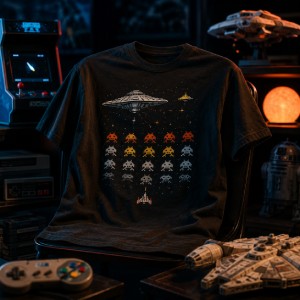
Pixel art gave birth to all this. Classic video game protagonists like Pac-Man or Donkey Kong could virtually be print on fabric since their structures based on squares and grid-mapping were graphical to begin with. As such, artists took that idea to the bank, and we fondly remember wearing shirts where nostalgia was served on a platter without needing to wring too hard. Nostalgia from the console age brought gratification when silhouettes of controllers, cheat codes, and fake achievement badges typecast accepted pleasers. The newest crop of hardcore gaming titles punched back with bringing minimal iconographies together with in-house cleverness that only satisfied the mention among players.
Then sci-fi and fantasy brought with them a whole different energy. Star Wars and Star Trek have bold and to-the-point designs, ranging from full starship schematics to slyly clever constructs that reward the occasional viewer. A drawing of the Millennium Falcon a la vintage travel ad or the Starfleet logo as a joke turned into luxury merchandise points on multiple sides at the same time. Some are desperately rooting for their fandom. While some of them hint subtly at the outsider across the room who shares their intuitive sense. Then, she entered the stage, burning invasion-control software by nuclear forces visiting wishes from beyond.
Both worlds share one instinct: design that earns its space on a shirt.
Code Jokes, Cult Designers, and Why the Shirt Still Matters
There’s a specific kind of satisfaction in wearing a shirt that reads “There’s no place like 127.0.0.1” and watching half the room miss the joke entirely. That’s the point. As Silicon Valley startup culture moved into public view through the 2000s and 2010s, programmers and developers found in graphic tees a rare way to signal identity without explaining themselves. Binary puns, command-line references, recursive humor – these weren’t just nerdy novelties. They translated abstract technical thinking into something physical and wearable.
Platforms like Threadless, TeeFury, and Redbubble gave independent artists the infrastructure to reach this audience directly. Threadless built its reputation on community voting and crowdsourced design. TeeFury ran limited 24-hour drops that created genuine urgency. Redbubble opened the door for any artist to monetize fan creativity without a gatekeeping middleman.
Taken together, these shirts endure because they carry so much at once – nostalgia, humor, tribal belonging, and a quiet kind of pride.
Geek Tees Still Say Exactly Who We Are
T-shirts bridged the long journey between nostalgia and blockbuster sci-fi, from niche fan gear to everyday wear. The big-bang culture made it visible, gaming made it emotional, Star Wars and Star Trek gave it mythology, and the tech community gave it wit. But the designs certainly never were so confined. They were a universal code: a very short moment of interaction between strangers–an unspoken signal that said, “same”. This is the reason everyone still keeps clasping onto them. People don’t put on a faded Pac-Man tee or some kind of binary joke on a rainy day because he or she enjoys either. That sort of shirt is a subtle expression to the world of oneself and his or her passions, needing zero justification.